
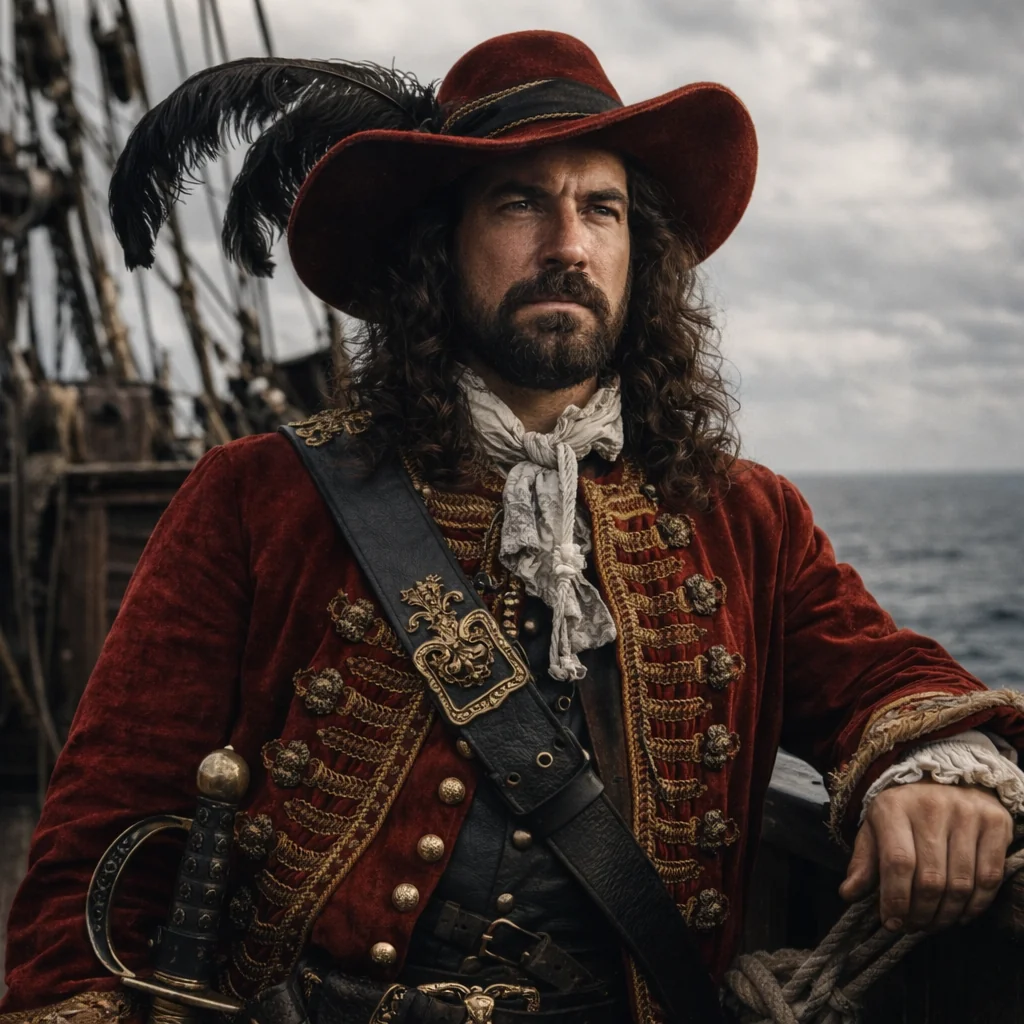
It’s April 1669 and the tail end of the Anglo-Spanish War rages across the Caribbean. Welsh buccaneer, Captain Henry Morgan, mid-thirties, has a fearsome reputation having plundered both Puerto Principe and Porto Bello (present day Cuba and Panama) just a year prior, humiliating the Spanish.
Admiral Don Alonzo was charged with ridding the Spanish Main of English piracy and commanded the Armada de Barlovento: three warships mounting 94 cannon between them, led by his flagship, the 48-gun galleon Magdalena. In Santa Domingo he received intelligence that Morgan had sailed deep into Lake Maracaibo to raid the towns of Maracaibo and Gibraltar, and now found himself caught in a natural prison: a bulbous lagoon with only one exit, a narrow 800-yard channel at the northern end.
Under full sail, Alonzo bore southward. He positioned his vessels across the channel sealing the escape route, then restored the garrison overlooking the narrows. Six cannon now commanded from the heights. It was a perfect trap.
Morgan, meanwhile, was sailing back up the lagoon toward Maracaibo when word reached him: a Spanish armada and a restored fort blocked his only way out. Escape by land was dire; the mountains rose sheer from the coast, and would mean abandoning millions of dollars, everything they’d risked their lives for.
It was, by any measure, an impossibility.
Morgan made his first move carefully. He sent a letter to Alonzo threatening to burn Maracaibo unless the Spanish paid him and let him free. He was testing the Admiral’s mettle.
Alonzo’s reply was swift and scorching. His mission was to hunt down Morgan to avenge his crimes against the Spanish Crown. But then he offered terms: leave all your treasure and slaves behind, and I’ll grant you safe passage. Refuse, then prepare for battle.
Morgan sat his men in the Maracaibo town square and read the letter aloud. Pirate ships were democracies of a peculiar kind. Only in battle did the captain hold absolute authority. At all other times, the men had their say, and they could vote their captain out if they chose.
“Do you want to surrender for your freedom,” Morgan asked them, “or fight?”
The situation was grim. Alonzo was a formidable commander leading well-trained Spanish forces with overwhelming firepower. A head-on assault through that 800-yard gauntlet would be suicide; cut to pieces by the Magdalena‘s guns and the fort’s cannon.
Morgan did what few commanders in his position would do: he asked the assembled crew for ideas. Not orders. Not directives. Ideas. Collaborative leadership in its rawest form, creating conditions for innovation rather than imposing solutions from above.
For the next several days, the harbour at Maracaibo echoed with frenzied construction.
Spies brought intelligence: the pirates were fortifying their vessels and preparing for a head-on assault, they said. Understanding this, the Spanish Admiral ordered his men to ready defences. At the chokepoint of Lake Maracaibo, Alonzo waited.
One morning, days after the final exchange of letters, Alonzo sighted Morgan’s fleet on the southern horizon. Thirteen small ships, just within view. Among them, one large trading vessel now flying Morgan’s flag, confirming the intelligence reports. The fleet waited.
Two days later, at dawn, the big trader raised anchor and sailed directly toward the Spanish line, joined by two others.
Alonzo must have smiled.
When the ships came into range, Alonzo unleashed everything. All 48 guns of the Magdalena exploded in a torrent of iron, tearing through sails and rigging and splintering timber.
Still the ships approached.
To Alonzo’s astonishment, they were attempting a head-on assault. A suicide mission. His cannons blasted the lead vessel again and again. Against the dim dawn sky, he could see the silhouettes of pirates on deck, weapons drawn, bracing for impact.
The ship crashed into the Magdalena.
Alonzo’s men surged forward onto the pirate deck, ready for close combat.
But, the deck was empty.
The silhouettes were wooden cutouts. In a gut-wrenching moment of realisation, the tar-soaked vessel ignited in flames. Gunpowder detonated and burning wood and ropes and canvas sail flung across the Magdalena, setting her ablaze. The gusting winds fed the inferno.
In the chaos, the crew of Alonzo’s second warship, panicked and their rigging jammed. Pirates chased her down as her crew abandoned ship. The Admiral’s remaining vessel fled to the fort, where the crew unloaded the guns and provisions before setting her ablaze to prevent capture.
The Magdalena and her 48 guns sank beneath the surface of Lake Maracaibo. Within hours, the Armada de Barlovento—an elite pirate-hunting fleet—had been obliterated.
The sounds of sawing and hammering from Maracaibo’s harbour had not been reinforcement.
Morgan’s men had cut false gunports in the old large trading ship with gunpowder-filled logs resembling cannon. They’d fashioned and dressed wooden cutouts of men brandishing cutlasses, then plastered everything in flammable oils and tar. The ship was gutted so it would blow apart without dampening the flames. They adorned it like a flagship. The buccaneer captain had waited for the strong winds, then a bare-bones crew sailed the fireship, ignited the gunpowder logs, and bailed out right before collision. The dusky morning combined with the impressive masquerade had impaired Alonzo’s ability to see the deception until it was too late.
Earlier, an informant had warned Alonzo about the possibility of a fireship. But Alonzo had dismissed the idea. He could not imagine that he, a Spanish Admiral, could be outwitted by a band of rogues.
Morgan’s collaborative leadership had proven otherwise.
But Morgan wasn’t free yet.
Alonzo still commanded the fort towering above the channel. He knew Morgan’s reputation: specialised in taking forts by land, as he’d done at Porto Bello and Puerto Principe. In the hours following the destruction of the Armada, some of Morgan’s men did approach the fort, and were gunned down by superior firepower. But, they’d have to neutralise the garrison or be shredded sailing through the narrows. Alonzo arranged his cannon landward and dug trenches to repel the coming assault.
Through the following day, Morgan ferried men from his fleet toward the landing site near the fort. Back and forth the canoes paddled; always full on the approach, always empty on the return. From high above, Alonzo watched. He was certain: a land assault was coming.
Then, in the twilight, Morgan’s ships silently raised anchor. They drifted through the channel on an ebbing tide before raising sail once beyond range of the fort’s guns.
Alonzo saw it too late. By the time he attempted to reposition his cannon, Morgan had escaped.
The landings had been a ruse. Men had paddled the canoes full toward shore, then laid flat in the bottom while the canoes were rowed back to the ships. Over and over. Not a single man had been left on land.
For the second time, Don Alonzo, a brilliant Admiral, had been played. The buccaneer fleet sailed unimpeded, carrying a fortune, back to Port Royal.
While Admiral Alonzo, a trained, seasoned military man, ordered his sailors top-down in their defences, Morgan checked his ego and created the conditions for collaborative problem-solving. Alonzo dismissed the intelligence received about the fireship, assuming the buccaneers could not possibly out-smart him. Then he was certain Morgan would attack the fort by land. Morgan watched the cannon positions and the men excavating trenches and adapted tactics on the fly.
In a turbulent, bleak environment, Morgan fostered a culture of experimentation, prizing adaptability and creativity. He demonstrated a balance between present operational demands and future vision, challenged orthodoxy, and displayed the courage to reimagine the art of the possible.
Today, digital and AI leaders face their own Maracaibo moment. Yet, over 350 years apart, while the tools have changed, the environment has changed, the principles and traits of great leadership remain. Every era is an era of change, but in periods of profound uncertainty, leaders do not fail because they lack information or tools, but because they overcommit to familiar assumptions, ignore blind spots, and awaken to strategic surprise when the window to adapt has already closed. Adaptability, creativity, vision, and judgment consistently top CEO surveys as critical leadership attributes for success. As it was at Lake Maracaibo, as it is today.
———
Endnote
Historical account based on: Talty, S, 2007. Empire of Blue Water: Captain Morgan’s Great Pirate Army, the Epic Battle for the Americas, and the Catastrophe That Ended the Outlaws’ Bloody Reign
read more: my thinking

© 2025 think provocative. All rights reserved.