Outcome Bias and the Seductive Rearview Mirror of Decision Making
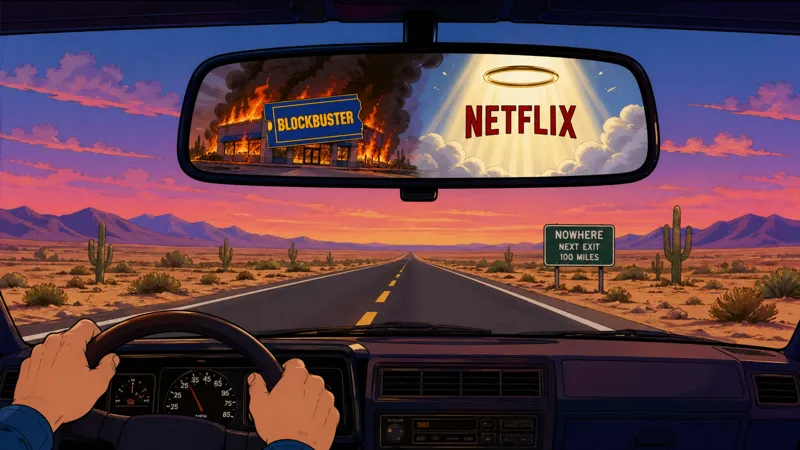
The Decision That Missed the Future.
It’s September 2000. After months of pestering, Reed Hastings and Marc Randolph finally secure a meeting with John Antioco, the CEO of Blockbuster. They pitch the sale of Netflix for $50M. Netflix would be Blockbuster’s online partner and their service would be promoted in-store. Antioco declines. Twenty years after their 2002 IPO Netflix was worth $150B. Blockbuster no longer exists.
In popular culture and business case studies Antioco’s decision is cited as one of the most catastrophic of all time. Headlines still today feature proclamations: “The $50 million decision that destroyed Blockbuster” and “Netflix History: How the streamer killed Blockbuster.” Blockbuster certainly had a bad outcome: In 2010 the 25-year-old company filed for bankruptcy. But did Antioco make a “bad decision” on Netflix? And did this decision directly precipitate the demise of Blockbuster?
Reviewing the case with hindsight it may appear a bad call full of hubris. Marc Randolph notes that Antioco barely held back his laughter at their proposal. The narrative from Netflix’s point of view is the scrappy, innovative disruptor that sunk a giant. But is it true?
The argument laid out below rejects this simplistic framing. First by adding colour to Blockbuster’s timeline and financial position. Second, recalling the late 90s and the decision landscape in front of Antioco. Which leads to the core point: Flagging outcome and survivorship bias. When that September 2000 decision is judged retrospectively, whether a decade or two later, it’s already tarred by the outcome. We know how the story unfolds and thus it seems Antioco should have too. But two other big events conceivably substantially contribute to Blockbuster’s decline: the adoption of the DVD and change in studio retail business models and the decisions of activist investor Carl Icahn.
But the real story here is cognitive bias in decision making and decision evaluation. We are all susceptible. The rearview mirror is seductive for its reductive sense-making, but it does not elevate decision making.
Systemic Decision Constraints: Forgotten Effect of Viacom’s Financial Engineering
Blockbuster’s first store opened in 1985. A year later, founder David Cook had a $6M warehouse as the main distribution point for thousands of VHS videotapes for his four stores. In 1987 he sold the company for $18M. With its aggressive expansion across America and internationally, Blockbuster in 1994 generated $2.9B in revenue and $243M net income from almost 4,000 outlets. Sumner Redstone’s Viacom bought Blockbuster in 1994 for $8.4B as the distribution arm of a vertically integrated media powerhouse. Earlier Redstone had acquired Paramount for $10B in stock and cash that left Viacom heavily indebted. By the late 90s Viacom held $15-18B of debt. Blockbuster’s cash generation helped stabilise Viacom’s balance sheet.
Under Viacom’s ownership, Blockbuster was initially harnessed as a cash engine for dividends and a distribution point for expansions in music and merchandise. When Antioco joined Blockbuster in June 1997, three years after the Viacom acquisition, the company’s cash flow was down 70 percent and the company was unprofitable. Antioco, a known turnaround executive, shed non-core businesses including 378 Blockbuster Music stores and failed ventures with MTV merchandise, signed direct revenue-share deals with Hollywood studios, and five years later had grown revenues to $5.8B. For most of the late 90s through to the bankruptcy, Blockbuster posted net losses and interest payments alone drew $100M+ per year. Blockbuster went from a relatively clean balance sheet to heavily indebted.
Then in 2004 as Blockbuster was spun out, it borrowed approximately $1.45B to fund a special $5-per-share dividend to Viacom investors, driving another huge spike into its coffin. This leveraged recapitalisation left the newly independent Blockbuster with over $1 billion in debt. The financial engineering that drained the war chest since 1994 left it was little room to manoeuvre and little free cash to invest in innovation.
The Late 90s Dotcom Era: Antioco’s Decision Landscape.
Investors shovelled cash into the anything-dotcom furnace. The Nasdaq peaked in March 2000 at over 5,000 points. Then like a rollercoaster hitting the apex it careened over and plunged downhill. A Barrons’ article highlighted the burn rates of internet companies. When Hastings arrived in Dallas in the autumn, the party was over. By September the Nasdaq had fallen 32 percent from the March peak to 3,500 — the dotcom bubble had burst and Internet companies were haemorrhaging cash and collapsing. The Nasdaq would continue falling to below 1,500 and would take 13 years before it passed 3,500 again.
In popular culture The Simpsons featured an episode in 2002, at the Nasdaq’s depth, where Bart creates a cartoon series called “Angry Dad.” Bart sells his creation to a tech firm who brings it online. In the scene the tech boss says “in five minutes it’ll be on the world wide web.” Bart replies that he can’t wait that long. “To pass the time help yourself to some more stock,” the tech boss resolves. That stock is indicated by a roll of toilet paper on the wall. The gag was that paper stock treated as currency was worthless.
It is in that environment that Antioco hears the offer to buy a future online business (Netflix would not have steaming for another seven years) that may eventually make money. Netflix in the autumn of 2000 was a mail-order DVD business with 300,000 customers on track to lose $50M that year. Antioco was in the midst of engineering a turnaround for Blockbuster that had around 6,000 stores and $5B in revenue, but with net income in the red. Investor sentiment turned sharply against internet companies and interest rates were being hiked. Right then in September 2000 in Dallas, he was effectively being asked to bail out Netflix. Far from being a sure thing, the odds were against Netflix becoming anything but a liability. Statistically the probability of success for Netflix was arguably less than 10 percent.
And at the point of decision: what are the possible outcomes? what is the payoff? and what is the probability of each outcome? Given the high failure rate of startups (VC strategy is built on hundreds of bets that fail for one that succeeds) and the financial position of Blockbuster, did Antioco really make a “bad decision” by declining a $50M bailout that Blockbuster couldn’t really afford? How likely was their one bet to payoff?
Or did he make a prudent strategic call given what he knew at the time?
The Netflix Decision: Outcome Bias and Survivorship Bias
What the business case history often forgets is that by 2004 Antioco shifted strategy. He saw from the embers of the dotcom flames that the Internet was a growing utility. Netflix IPOs in 2002 with 600k subscribers and by 2004 they pass 2M.
Antioco launched Blockbuster Online and Total Access which allowed a renter to return a mail-order DVD to a retail outlet and get another free of charge. He also tackled the biggest customer gripe, late fees, albeit underhandedly essentially re-categorising them as “extended viewing fees,” which was a public relations disaster. Still, on their financial statements, those fees accounted for $622M. Within a year Blockbuster Online had 2M subscribers and by 2007 was growing faster than Netflix.
Hasting later acknowledged that he was seriously concerned that Blockbuster’s strategy could win the day. On the sidelines of the Sundance Film Festival in 2007, Hastings offered to buy Blockbuster Online.
Of course the enormous unknown was if Netflix would ever have become a behemoth had Antioco bought it in September 2000. Coming from a retail background, Antioco and the Blockbuster corporate culture would arguably not have gelled with the startup culture of Hastings. The entire acquisition more than likely would have been disastrous. And hugely costly. Most mergers and acquisitions fail to generate synergies often due to a corporate culture clash. Business case books are littered with them and instead of the Blockbuster/ Netflix story being one of apparent “catastrophic decision making,” for lost opportunity, it make just have been “catastrophic decision making” for a different reason, a failed merger.
Given the sharp downturn in investor sentiment for dotcom businesses in late 2000 and Blockbuster’s own debt issues, Antioco’s decision to pass on a startup set to lose $50M that year seems financially reasonable.
If Netflix had failed in 2001, which was more probable at the time, that same decision would be celebrated as prudent. So the bias cuts both ways. The Blockbuster/Netflix story only exists because Netflix won. That is outcome bias in its purest form: we judge the decision by the survivor, not by the odds.
The Icahn Decisions: When Short-Term Logic Overrode Long-Term Strategy
The standard narrative casts John Antioco as the CEO who missed the future. But Antioco’s own account reveals a different truth: by 2004, Blockbuster had pivoted. They launched Blockbuster Online. As Antioco writes, “We had successfully slowed Netflix’s momentum.” The strategy was not a failure of vision; it was a success in motion.
Enter Carl Icahn. Icahn’s expertise, Antioco notes, was in “making investors rich,” not in “helping to set a company’s strategy.” A rational actor with a different mandate. When Icahn won seats on the board after a proxy fight that Antioco admits was “doomed from the start” (because Blockbuster’s shareholders were hedge funds chasing quick pops), the company’s time horizon collapsed.
Icahn fought the executive bonuses in 2007 after the one year Blockbuster turned net income positive in 2006. Antioco was effectively fired by Icahn with a $5M severance. Icahn disagreed with the removal of late fees, he felt Blockbuster overinvested in digital strategy, and the new CEO abandoned it in favour of a re-focus on retail stores. They raised online prices. They cut marketing. They chased a doomed acquisition of Circuit City.
Watching from the sidelines, Antico did something telling: he sold his Blockbuster shares and bought Netflix. “I could see that Netflix was going to have the whole DVD-by-mail market handed to it.”
The tragedy of Blockbuster, then, is not that they declined to buy Netflix or that they refused to pivot. Partly it’s that they built a credible response, only to have it dismantled by a governance structure that valued quarterly extraction over competitive survival.
So Much More on DVD
One part of the Blockbuster story that is left out is the technology that really contributed to it’s downfall. Not streaming, but DVDs. In 1997 the DVD hit America. By 1999 there were 4M households with DVD players and by 2002 you could buy one for about $80. Eighty percent of US households owned one by 2004 and the DVD market topped out at $24B in 2006.
That’s a massive market size in less than ten years.
More critically for Blockbuster was that studios could manufacture DVDs faster and cheaper than VHS tapes and wholesale them for $3 to big box retailers like Walmart and Best Buy that then used them as loss leaders for store traffic. For comparison, VHS tapes used to sell to rental outlets for $100. Movie studios made revenue indirectly through rental in the VHS years and their strategy shift toward direct to consumer had big implications for the rental market.
Consider that closely. Before Netflix was streaming, another technology and business model disrupted the market rapidly. Suddenly, Walmart and hyper-retailers are huge competitors for Blockbuster at scale. Instead of renting a VHS the customer could now just buy the new release DVD.
All of this context matters for one reason: it shows how many variables stood between the 2000 meeting and the 2010 bankruptcy. Yet the popular story isolates a single decision. That’s outcome bias in action.
The Decision That Sunk Blockbuster, Revisited.
News headlines proclaim the $50M missed Netflix deal that eventually bankrupted Blockbuster or similar statements to that effect. As demonstrated, it’s a narrative with a heavy dose of outcome bias.
There is no direct line between this decision and the eventual collapse of Blockbuster. Antioco by 2004 began investing in Blockbuster Online and Total Access, units that were recharging growth. So rapid was Blockbuster’s renewed vigour that Hastings was worried and even offered to acquire the online business.
So then what led to Blockbuster’s bankruptcy?
Short answer: Many things. Many decisions.
Viacom’s ownership and the $1B in debt to fund a shareholder special dividend when Blockbuster was spun-out, the mass adoption of the DVD and studios wholesaling to big box retailers making Walmart an enormous competitor, Carl Icahn’s short-term misalignment and the firing of Antioco, the subsequent scrapping of Total Access and the re-instatement of late fees. All of these decisions and “bad luck” events arguably tightened the noose around Blockbuster’s neck.
Decisions are made with uncertainty. And it’s pleasing for some to look back with the benefit of hindsight and single out a moment in September 2000 and suggest that Blockbuster’s fortunes would have changed in that Dallas office. But that dismisses the two wildly different business models and cultures and the fact that Netflix at the time had a very low probability of succeeding.
Looking back from a distance of two decades with Blockbuster in the grave and Netflix as the $150B winner. Of course, we think, John Antioco erred in his call to dismiss the opportunity to acquire Netflix for a mere $50M. What an extraordinary return he would have made.
Separating Decision from Outcome: What This Means for Decision Making
Netflix had a higher probability of failure in 2000. And it’s a testament to the tenacity, smarts, guts, and determination of Reed Hastings and his team, and probably a good dose of luck that consequent decisions by Blockbuster’s board hampered their resurgence.
One of the hardest things to do mentally is to separate decision from outcome. Whether looking at a corporate case like Blockbuster and Netflix or a personal decision to buy a new car, move house, or change jobs. Revisionist narratives tying outcome to decision cloud objective judgment.
Real decision-making is messy. Good decisions can have bad outcomes. And frankly, the term “dumb luck” exists for a reason. The game is not played with just two actors. A decision today sets in motion a series of events and consequences and downstream decisions by other parties that influence, inhibit, and interfere with the pathway toward a possible outcome. Decisions involve uncertainty, constraints, and luck. And the only way to evaluate a decision fairly is to ask: ‘Given what they knew at the time, was this a rational choice?’ Not: ‘Did it work out?’
We cannot control the future, but we can control the rigour of our process. Outcome bias and hindsight are emotionally seductive because they offer the illusion of a world that makes sense. But leadership requires the discipline to look past the rearview mirror. We can build basic decision making processes: Documenting pertinent knowledge at the time, making sense of data, asking counterfactual questions, seeking uncomfortable opinions, considering possibilities, payoffs, preferences, and probabilities of success. These tools allow us to judge a decision by the quality of the thinking that produced it, rather than the luck of the result.
see more: my thinking