
Genghis Khan: How a Steppe Barbarian Built a 13th Century Empire on Resilience, Adaptability, and Innovation
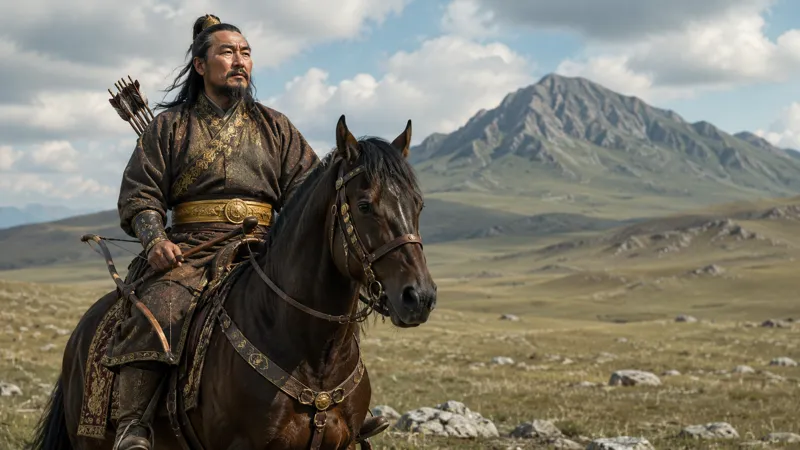
A Land of Horses, A People on Horseback
A young man and his wife ride on horseback across the great plains of Central Asia on a mild spring day sometime in the mid-12th century. The scent of fresh grass fills the warm air. Plodding along the horse snorts and flicks its tail. She is sixteen and he had worked for her father many years to earn her hand.
Alone they ride in the sunshine, when from a knoll above three rogues of a rival tribe swoop down. Instantly she commands her young husband to flee. The rogues only want to kidnap her, she knows. And outnumbered he would be slain on the steppe. The man flees the marauders who take her captive back to their encampment. A man who could not earn a wife takes possession however he can. Soon the young girl bears her kidnapper a child named Temujin.
That child born to a kidnapped mother would become Genghis Khan, the greatest ruler of the steppes. He would build an empire that stretched from the Pacific Ocean to the Mediterranean Sea, from Moscow in the north to Baghdad in the south, incorporating Chinese dynasties, Muslim sultanates, the Persians, Europeans, Christians and Jews. His name would reverberate across 800 years of human civilisation.
The contemporary portrait of Genghis Khan is the wool-coated barbarian who swept down with hordes on horseback to pillage and plunder all before them. Who brought violence upon all, spared none, and whose name instilled fear across the lands. Yet how did a steppe barbarian manage not just conquer mighty civilisations with lesser forces, but hold the territory and grow an empire? Over forty years of war campaigns how did he not fall victim to his own success? In capturing such distinct empires how did he navigate the merging of cultures? In short, what kind of leader was Genghis Khan?
Resilience Born of Sacrifice and Hardship
His mother’s name is Hoelun and by commanding her young husband to flee that spring day on the steppes she sacrificed herself to save his life. Years later when Genghis Khan is a young boy, the tribe of Hoelun’s husband takes revenge and kills his father, Yesugei, the kidnapper. Hoelun now with six children under her care is abandoned by the tribe.
Temujin, about nine years old, had been in the service of the father of his future bride, Borte. He leaves her and races across the plains back to his mother to help fend for the family that includes Yesugei’s second wife and her two children—his older half brothers. Soon a power struggle ensues and Temujin kills his oldest half brother. Now he’s a wanted man (boy). He’s captured by the powerful rival tribe, shackled and enslaved. Eventually he escapes thanks to the kindness and life-risking actions of a poor family of the encampment. He’s sixteen when he returns to Borte to find she waited for him. They marry and ride back across the steppes. Now he is the head of a household.
It’s at this time, another large rival clan, sweeps down on their encampment and kidnaps Borte. Temujin and his brothers escape on horseback across the grassland finding refuge in the forest of Mount Burkhan Khaldun. He is said to be heartbroken—a highly unusual display of vulnerability. Praying at this mountain he faces the first big decision of his young life—go after the kidnappers and rescue his wife or face a life of loneliness, for no father would give his daughter’s hand to a man who had a wife kidnapped. At sixteen Temujin leads a raid with allies he founded earlier, a surrogate father and his best friend, and reclaims Borte.
The First Innovation: Breaking Tribal Tradition.
From his upbringing Genghis Khan observes the never-ending back and forth of tribal raids, kidnapped women, looting, and enslavement. One tribe is defeated only to come back at a later more opportune time and raid the other. It’s a vexing problem. Are we eternally going to fight back and forth, he wonders. By his early twenties he had defeated rival Mongolian tribes and his renown and following grew.
Once Genghis Khan had defeated the Tartars, a large ancient tribe consisting of thousands, he wrestled with the problem of the groups splintering along the old traditional bloodlines. His solution was to offer kinship and protection to all that submitted. Conquered tribes would not be enslaved. The people would be treated as equal members of society. They would share in the future victories and spoils.
Everyone served in the army or undertook public service one day a week. He promoted inter-tribal marriage. And eventually he would give a name to the realm: People of the Felt Walls, representing the gers, the traditional circular tents in which they lived.
Leadership of Merit, Not Pedigree.
Genghis Khan loathed the old aristocratic hierarchy in Mongol societies. By breaking aristocratic monopolies on leadership, he created a command structure where competence, not birth, determined who held power. Most radically, he implemented military reform.
Squads of men were formed across tribal and family lines with the instruction to treat each other like brothers. Using the decimal system, he formed squads of ten men. Leaders were picked by the men in the squad, much like pirate captains were voted in by the crew.
Ten squads made a company of one hundred. Ten companies formed a battalion of one thousand. Again, leaders were picked by the men. An army of ten battalions, ten thousand men, had its leader handpicked by Khan, on skill and ability no matter the family or station from which they came.
The Great Laws: Applied to All, including Genghis Khan
Recognising the need for common law across a growing swath of territory, Genghis Khan decreed the Great Laws, a dynamic volume of basic laws. However, he allowed for the continuation of traditional rules and customs in each part of the empire so long as they didn’t contradict the Great Law.
Recalling both his mother and Borte, first he outlawed the kidnapping of women, the selling of women into marriage, and the enslavement of any Mongol. He declared all children legitimate, regardless of the circumstances of their birth. Animals of the plains were the lifeline of Mongol society providing sustenance and resources for clothing and shelter. Continual raids over the centuries dispossessed people of their livestock. Genghis Khan made animal theft illegal, but further, anyone who came upon a lost animal had the duty to find its rightful owner.
Further cementing animal protections he declared a six-month hunting off-season to ensure adequate time for animals to breed. And during the winter quotas were placed according to need. Arguably a world-first, he enshrined religious freedom for all. Not only that, but religious leaders, along with essential services like doctors and teachers were exempt from taxes.
Again, taking the lessons of his childhood, he foresaw the potential for intra-family violence when he passed. To head off any power struggle for the office of Khan, he decreed that any family member claiming the highest office must be elected by khuriltai—a traditional Mongolian grand council attended by representatives and leaders of all the families and tribes. By turning up they demonstrated their support or “vote.” Absence indicated they did not support the new Khan. Nobody could claim that high office without election.
But in probably the most significant deviation from the monarchistic laws in Europe, Genghis Khan declared the Great Law applied to everyone, even the sovereign himself. Whereas in Europe the nobles, religious leaders, and monarchy were rarely subject to the laws they decreed on their peasants.
Harnessing Expertise: Scaling What Works
Genghis Khan understood that the Mongols were herders, hunters, and warriors. They were not craftsmen, miners, smiths, or scribes. Rather than trying to diversify his own people’s skill set, he leveraged the talents of others.
When the Mongols conquered Chinese territories south of the Gobi, including Hangzhou, Khan recruited Chinese engineers. These experts brought advanced siege weapons, such as catapults, and entire corps were integrated into future Mongol armies. He institutionalised this approach by creating dedicated engineering units and standardising successful tactics across the empire, turning isolated experiments into repeatable practices.
Similarly, upon conquering Muslim lands extending to Baghdad, Khan encountered a population with high literacy rates among even ordinary civilians. Muslims became the scribes and scholars of the empire. He integrated astronomers, judges, engineers, imams, rabbis, and priests. Weavers, leather workers, furniture makers, jewellers, singers, and entertainers all found their place within the Mongol society.
Khan absorbed and integrated foreign knowledge rather than erasing it. For instance, the Koreans produced paper, which became a vital resource for documenting Mongol history and laws, as well as for spreading propaganda. Khan realised that if a city could be defeated through propaganda alone, so much the better.
His ultimate aim was always to preserve Mongol life. This stood in stark contrast to European armies, where lords and monarchs readily sacrificed the lives of the poor in their war efforts. The Mongol empire grew by absorbing cultures, not imposing theirs.
Continental Communications: A Radical Innovation
Governing the largest contiguous land empire in history required more than armies and laws. Once again taking influence from conquered cultures, Genghis Khan built the Yam, a post-office network of sorts, a vast relay that served as the empire’s communication backbone.
Spanning thousands of miles, from the sunrise in the east to the sunset in the west, it connected distant provinces and would become the largest and fastest such network the world had ever seen. Marco Polo is said to have noted that messages could travel over 200 miles a day, an astonishing feat in the early 13th century.
The system was built on discipline and standardisation. Relay stations were placed roughly a twenty miles apart, stocked with fresh horses, food, and shelter, and manned by local families. Couriers traveled in shifts, passing sealed messages from one rider to the next without stopping. Official travellers carried a metal pass called a paiza, an early version of a passport, which guaranteed them fresh mounts and supplies at any station.
The network was operated by the army and protected by law; harming a courier or stealing from a station was punishable by death. Khan staffed the Yam with trusted personnel turning scattered outposts into a single, synchronised machine.
The Yam integrated with and improved the Silk Road trade routes. Merchants moved goods under imperial protection. Military orders reached distant generals in days instead of months. Scholars, diplomats, and envoys crossed deserts and mountains with reliable support.
For the first time in history, with a continuous artery of communications, a single administration could monitor and direct affairs across an entire continent.
What can we learn from Genghis Khan?
This is just a snapshot of Genghis Khan’s life and legacy. But far from the contemporary image of the barbarian hordes, Khan thought about the people, the institutions, the governance, and the succession of his empire. The Mongols were antithetical to the bloodthirsty, gruesomely torturous, and religiously fanatic European leaders and armies.
Even in later centuries, men of science were tarred as heretics and horrifically executed in France, Spain, Italy, Germany, and England. Galileo died in 1642 under house arrest, escaping the stake only because he recanted. In England the beheading pirates and criminals and the impaling of those heads by the estuary of the Thames was commonplace.
Given the context of his environment, Khan instead was open-minded, thoughtful, and benevolent. He focused on trade, commerce, and the integration of cultures and the spread of ideas. He smashed hierarchies and aristocrats. He promoted on loyalty and merit and skill, not familial ties. And he instituted protective laws for women, children, and animals, decreed freedom of religion, and held himself and his heirs to the Great Law. Whilst outlawing the kidnapping of women might not seem radical in 21st century society, 800 years ago on the violent and nomadic steppes it was truly maverick. Genghis Khan’s thinking and institutional administration was revolutionary—long before organisational design theorists, leadership bootcamps, cultural training consultants, and MBAs, even before widespread basic education.
Genghis Khan was not literate. He grew up in the marauding brutality of the steppe. His father was murdered. Then he killed his own older half brother in a power struggle. He was enslaved. Nobody taught him the skills of life and leadership. He learned through trial and error and sacrifice. His path to leadership, to rule an empire, was anything but assured. Every battle was against bigger odds. Every army bigger and more advanced. And yet, somehow he stitched together a tapestry of cultures and religions and ideas and innovation from the Pacific to the Mediterranean.
His empire afforded him anything he could imagine, and more. Easily he could have sucked up the wealth of conquered civilisations and slept on a bed of gold, mirth, and exotic furs, leaving the peasants to freeze in the winter. Yet he didn’t.
Caravans of treasure brought from distant lands were bequeathed to the People of the Felt Walls. Young girls that milked goats had silks and furs and fine jewellery. But Genghis Khan shunned ostentatious displays of wealth and rejected the spectacle and lavishness of the rulers of civilisations he conquered. In a surviving letter he says: “I wear the same clothing and eat the same food as the cowherds and horse-herders. We make the same sacrifices, and we share the riches.”
In his old age he told his sons that self-control was the foundation of leadership, along with keeping ones pride and anger in check. He warned them against sloth: “It will be easy to forget your vision and purpose once you have fine clothes, fast horses, and beautiful women.” The wisdom Genghis Khan shared with his sons itself resonates through time to the Stoics hundreds of years earlier.
This tells us these principles are timeless. There is no grand secret to leadership. No one ideal framework. Core principles echo from those ancient steppes: Resilience, true grit, adaptability, courage of conviction, staying true to values, harnessing talent you don’t possess, innovation through learning, and remaining humble.
Who knows where that might lead you.
read more: my thinking