
Clash of Cultures: Buccaneering Adventures in Leadership
Sometimes leadership lessons and the cultures that ignite them come from unexpected environments.
Part 2: Revisiting the story of Captain Henry Morgan and Admiral Don Alonzo at the 1669 Battle of Maracaibo with a deeper dive into the systemic cultures and organisational constraints that shape both leaders: Two Styles of Leadership Built on Two Different Cultures
Read Part 1 here: Radical Leadership Amid Uncertainty
That Henry Morgan, the pirate captain, outmanoeuvred and outwitted the Spanish Admiral Don Alonzo at the battle of Maracaibo in 1669 is a matter of historical record. Outgunned and facing superior Spanish military trained sailors, Morgan’s band of raiders found a way to defeat and then evade the Admiral.
Not only up against a Spanish armada, but the geography. Lake Maracaibo, in modern day Venezuela, where Morgan’s crew had been pirating is shaped like a light bulb. One small entrance, 800 yards wide, at the north over which a fort and cannon stand. Admiral Alonzo, the pirate hunter, had chased after Morgan across the Caribbean Sea upon hearing his location and seemingly had him trapped in the bulb.
Morgan, after having his audacious letter demanding the Spanish stand down lest he raze the town of Maracaibo, rejected, set about conferring with his men in the town square. He laid out the scenario and the stakes. The men could not escape over land due to the mountainous terrain, and they would give up millions in loot in that process. Either they would surrender to the Spanish and face charges and probable execution as pirates, or they would fight.
The men chose to fight. With the objective set, the captain asked the men for ideas.
While Alonzo fortified the garrison overlooking the channel exit, Morgan’s men hammered away and modified their ships, preparing for battle.
Days later, Morgan’s ragtag fleet lined up on the horizon as Alonzo’s overpowering firepower, 94 guns between three ships including the 48 gun war galleon Magdelena—over 6 times bigger than Morgan’s flagship, held fast. Alonzo believes he cannot lose. Morgan has but one-third of the cannon with a flagship carrying just a dozen.
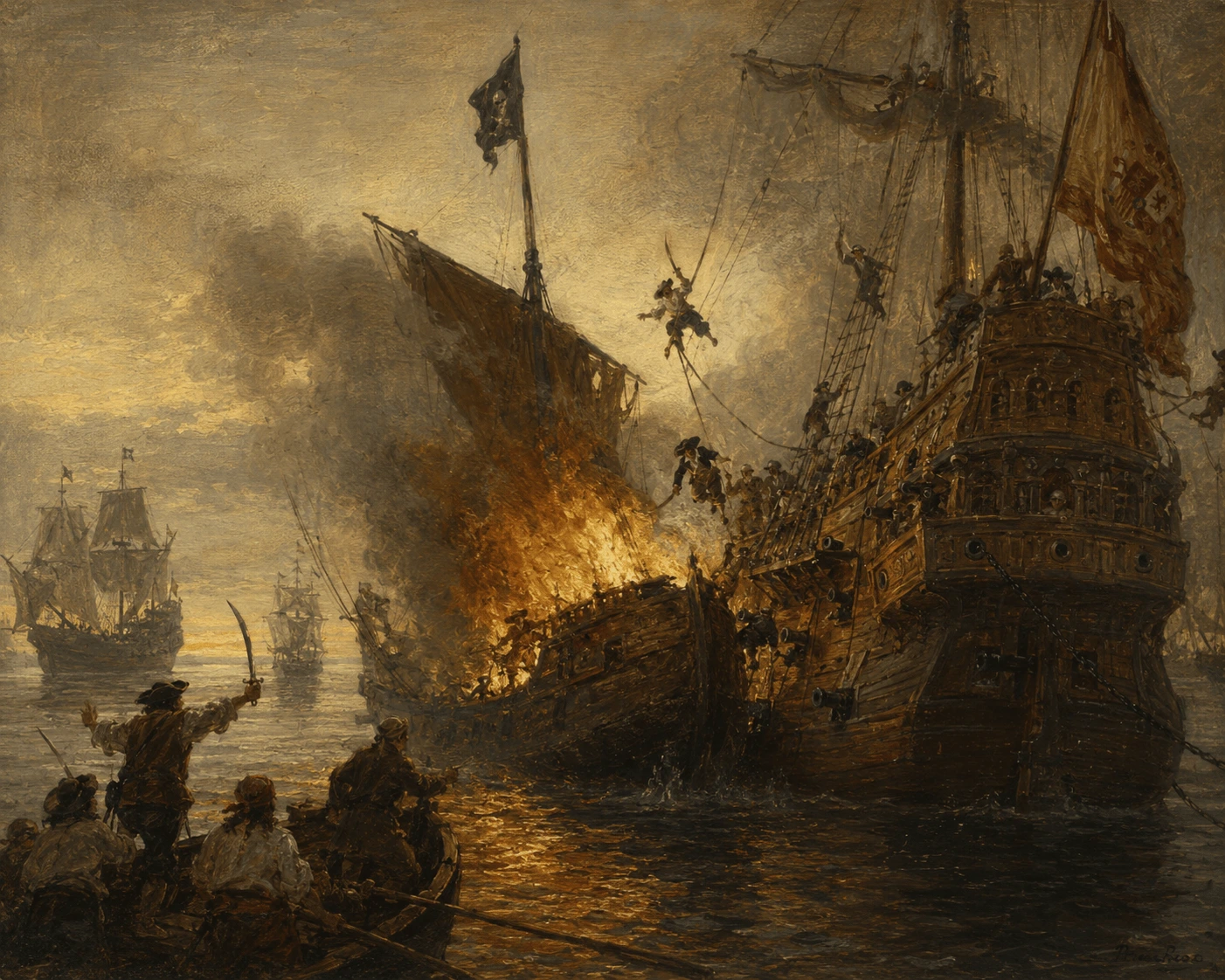
Under the cover of a dusky morning, the pirate captain sailed three ships directly at the Spanish line—a suicide mission. The Admiral’s cannon thundered iron and chain and tore through the large lead vessel, yet it continued head-on. Alonzo saw the pirates on deck brandishing their cutlasses. The pirate ship slammed into the Admiral’s galleon and, in an instant, gunpowder exploded and set on fire. Tar soaked ropes and timbers aided by gusty winds quickly engulfed the Spanish warship.
Chaos and panic ensued. Spanish sailors tried to steer a second ship away. It was chased down by the pirates and captured. The last remaining Spanish vessel retreated to the safety of the garrison and Morgan’s men gave chase.
Within hours the massive 48-gun (very expensive) Spanish war galleon sunk to the bottom of the lake.
Regrouping, the Admiral secured his post at the fort with his remaining men. Morgan was still trapped. Running the gauntlet would surely see his ships smashed by the fort’s cannon.
Both men observe. Alonzo knows Morgan’s reputation. His recent plundering of the forts at Puerto Principe and Porto Bello cemented his reputation as an expert land raider and this was surely at the top of Admiral Alonzo’s mind as he watched boats full of men rowed toward to the shore and row back empty to re-load more men to land on the beachhead. Alonzo believes Morgan is about to attack the garrison, after all it’s his only way out. He set the cannon landward and ordered defensive trenches dug.
Night passes.
Then in the twilight Morgan’s ships raise anchor and drift out of the channel on the tide. Alonzo is alerted and he ordered the cannon moved, but it’s too late. Out of the channel and beyond the gun’s range, Morgan raised sails, escaping with millions in booty.
Admiral Don Alonzo defeated, twice. It beckons the inquiry, how?
The Fireship, Innovated
It’s not that Morgan is smarter. Nor that Don Alonzo isn’t experienced, lethal, and highly capable. But there are key moments over these days in April 1669 that attest to two radically different cultures.
When Morgan sits his men in the town square of Maracaibo, and reads Alonzo’s scorching reply, he asks for ideas. The objective is clear. The men want to fight their way out. But how?
Calling for ideas means Morgan must admit he does not have the answers. It’s a move, not only governed by the ship’s articles, but of humility. He sought the wisdom of entire crew.
Surely the legend of Francis Drake had echoed through the taverns across the Main. Drake the English buccaneer who eighty years earlier had surprise attacked the Spanish armada off Calais by setting ships ablaze at night and sailing them at their line causing panic and scattering the Spanish war fleet. Drake’s psychological warfare set up the battle which saw dozens of Spanish ships destroyed—at the time Spain’s worst strategic naval defeat.
Set fire to one of the ships and sail it at Don Alonzo. Might that work here?
It’s unconventional. But being severely outmatched the crew must adapt, be creative, and do something unpredictable.
Morgan’s fireship however adds something new: magnificent theatrics. The men which Alonzo saw on the fireship were not men but dressed up wooden cutouts. And the dusky morning made that hard to identify. Morgan had cut additional cannon ports but planted decoy gunpowder-filled logs designed to explode. Then the entire vessel had been doused with tars and oils for maximum ignition.
The Intelligence, Rejected
On the Spanish war galleon, Alonzo had sent out spies. They returned from the jungles around Maracaibo and reported the feverish hammering and construction noise. Their assumption was Morgan was fortifying ships for a naval battle.
But one informant (a slave that escaped from Morgan’s camp) told the Admiral of the fireship.
Alonzo dismisses this idea.
What is curious is that he would have institutional knowledge of both Francis Drake and the fireships of Calais and, three years prior, of the Antwerp “hellburners,” ships packed with explosives.
Setting vessels ablaze was not a new tactic. But he does not believe that Morgan’s men have the skill to build such a vessel. He gives the orders to ready defences. The Spanish sailors prepare for a conventional assault.
The Admiral’s Assumptions and Morgan’s Adaptiveness
History shows the fireship was real. The mighty Magdelena was sunk. And the Admiral fled in a canoe to the fort. The next chapter unfolds with Alonzo’s assumptions: Morgan is a land raider, he will attack the fort.
But from his ship, Morgan sees the defences being readied. While it was true that his mastery was storming forts and he was amateur at sea, he adapted his tactics.
He had men climb down from the flagship into rowboats in clear view of the fort. They then rowed to the beach. Under cover of the scrub out of sight of the fort, the men simply lay down and the oarsmen rowed back. No men were landed. Canoe after canoe played out a ruse all afternoon as Admiral Alonzo looked down.
The Admiral never queried his own assumption about Morgan’s tactics: What if Morgan didn’t attack the fort? How else might he escape through the channel?
Two Styles of Leadership Built on Two Different Cultures
In some ways the Spanish Admiral is captive to his own military culture. It is hierarchical, rigid, and process-driven. On the open ocean in conventional naval battle, that worked. And his strategy is sound. He blocks the only exit from Lake Maracaibo. He re-arms the fort. He knows Morgan is not a master of naval battle. The deck is stacked heavily in his favour and victory ought be assured.
Except he cannot adapt when circumstances change. Even with a forewarning of the fireship, he does not consider the possibility of being outwitted.
Don Alonzo is a nobleman who sits in high office. A man likely appointed through connections over competence. He doesn’t consider his enemy, the band of rogues, to have the intellect and wisdom of his refined military training. As an officer of the Crown, he looks down on these men as mere thugs. Violent, but thugs nonetheless.
The Spanish military is one of protocol, governance, and royal decrees, and the Admiral had responsibility for Crown resources: ships, men, guns, bullion. Under this system, he could be held criminally liable for losses. Following protocol as instructed and mitigating risk, but suffering a loss was defensible in court. That adherence to protocol at Maracaibo is what saved Alonzo later under court-martial in Madrid.
Morgan on the other hand was appointed not by a higher authority, but by his men. Pirate articles established the captain as the first among equals. A captain earned two shares to a crewman’s one. Furthermore the captain only held absolute authority in the midst of battle and under imminent threat. The organisational structure was far more democratic in that each crewmen had a vote. That extended to judicial proceedings (the captain was not judge, jury, and executioner), the admission of new recruits, and most crucially the appointment and removal of officers, the quartermaster and the captain himself.
To be sure, working conditions were incredibly dangerous, brutal and harsh in the 17th century (everywhere in the 17th century), but it has been often said that a buccaneer crewman was treated far better than that same lowly sailor in the British Merchant Navy—where a Royal Navy captain could judge and flog or hang sailors on command. Quite probably Morgan’s crewmen were more fairly treated and compensated than those under Don Alonzo.
It’s an uncomfortable truth that perhaps the most progressive working conditions of the 17th century were on pirate ships. That these men had agency where the working-class and destitute elsewhere had none. Under these conditions, where Morgan had to earn the trust and respect of his men, where he served at their pleasure, the incentives between himself and the crew were arguably more closely aligned. When a captain could lose his job and status, indeed his life, for poor leadership at the hands of his team, it lays the conditions for a culture of collaboration.
It’s that bedrock culture that spurred the collaboration, innovation, and adaptability displayed at Maracaibo. Not Morgan’s superior genius.
Imagine if You Could Fire Your CEO
Every year glossy consultancy reports announce surveys of senior organisational leaders questioned on what drives “human capital” and the traits they seek and support. It’s a regurgitated word-melange: creativity, courage, empathy, self-awareness, curiosity, agency, psychological safety, and human judgment.
Throw a dart at any yearly press release.
But words without action are platitudes. More than that, they are insulting to the intelligence and good nature of the people who toil under these leaders.
Companies say they want curiosity and imagination, but they do not reward those things. Harvard Business Review reported that huge disconnect: 73% of leaders said curiosity and imagination are critical, but only 9% of workers said those same leaders supported or encouraged curiosity through the exploration of new ideas.
That isn’t an isolated data point. Take workplace wellbeing. An overwhelming majority of leaders (77% in a Deloitte survey) believe their organisations have improved employees mental wellbeing, yet only 33% of those workers agree.
Those numbers would have the captain walking the plank.
Unsurprisingly then, workers are not engaged at work. Gallup polling reveals just 20% of the global workforce is engaged with their job. Remarkably this is close to the high-water mark of 23% just a couple of years ago. I say remarkably because it is truly astonishing that a long-term trend of 80% of workers not engaged is the norm; remarkable that the high point is 3 in 4 people not engaged during eight hours of their day.
Worse, today in Europe 15% of the workforce is actively disengaged, while just 12% report being engaged. That distinction is striking. More people actively hate their job than love it. In the United States 17% are actively disengaged.
The slide toward active disengagement is stark. These folks are beyond just turning up and clocking in; they are actively hostile, resentful, and acting out that unhappiness.
Nowhere has engagement risen this past year.
Seems there is a lot of bullshitting. Or incompetence, blindness, or all of the above. It’s reasonable to assume leaders are not incompetent nor unable to read surveys. So bullshitting it is. Because if year after year surveys report the same things—organisations must be more agile and adaptable, that employee engagement and psychological safety are paramount, and that creativity is a non-negotiable for success—then how are, at best, 3 in 4 people not engaged? What causes the 73% to 9% gap in between the rhetoric of curiosity and imagination and the coalface reality? Why do leaders believe they are improving wellbeing when staff say they are not?
System Says No
The system in which senior leaders operate often resembles that of Admiral Alonzo: hierarchical, rigid, politically driven. In reality, to reach executive leadership roles aspiring candidates must plough relentlessly for years, building competencies, but more importantly connections. Delivering against system determined metrics. Keeping their head above the crap-line. But not too far up for fear of being decapitated like a tall poppy. Crucially for success they must outlast competitors and excel at politics.
Yes, we know hubris plays a role. Climbing the corporate ladder raises one’s perceptions of their own competence and yet there’s poor correlation between that self-perception and reality—meta-analyses demonstrate it’s about 30%.
Look, it’s not hard to see how executives having toiled through years of a professional career, outlasting competitors, perfecting adherence to the system, arrive at the corner office full of hubris. Surely one who rises through the ranks of leadership to the executive suite must be an expert, much like Alonzo. Smarter, more competent, and a better strategist and tactician than anyone who might report to them. Being seen to have the answers is what makes one valuable. A challenge to that paradigm is not only potentially a mask-off moment, but a social and personal identity risk.
But that’s not all. Self interest and self service is darkly under-appreciated.
Once arrived all that work would be wasted should one fall from grace. Human instinct to protect the catbird seat is understandable. And therein lies the problem. The people tasked with transformation are the product of the system that needs transforming. Structurally the transformation requires them to challenge the system that selected them—jarring cognitive dissonance. An organisation that promotes people into leadership determines in advance the kind of leadership it will get, and therefore the kind of culture it can sustain.
Renegades Wrote it on a Napkin
“We began with the hypothesis that the human factor is the secret to success in transformation programs,” says EY, a Big4 consultancy in its 2024 feature. The research discovers, regarding organisational transformations, “emotions within the human dynamics are the strongest indicators an issue has emerged.” Simply, people, and how they feel, matter. Whether they trust those leaders, matters.
Somehow it feels like it shouldn’t take a multi-billion-dollar consultancy to state when shit is bad, it’ll be written on people’s faces long before “dominant lag indicators, such as KPIs that populate common dashboards.”
EY continues that leaders’ actions “must put humans at the center if they are to address the unique challenges facing the transformation.”
Said basically: Individuals and interactions over processes and tools. The Agile Manifesto told us in seven words what EY’s research did, for free, back in 2001. And it could all fit on a napkin.
Here’s the rub.
There’s a chasm between “doing agile” and being agile. Agile explicitly, militantly, rejected command-and-control project management. They argued for self-organising teams. In that self-organising team, a leader’s role is a servant-leader to the team who fosters an environment in which the team can perform their best work. The servant-leader removes impediments, adopts a coaching mindset, and seeks to genuinely improve those employees.
A leader must set goals and visions, objectives and constraints. In military terms, the Commander’s Intent. That is, what success looks like (escaping Lake Maracaibo) and why it matters (so we’re not hung by our necks). Critically for self-organising teams, it provides constraints (the box of resources). But it then steps aside for the “how” it’s done.
When people down the line are empowered to make decisions, as self-organising teams suggest, employee engagement rises, productivity improves, as does financial performance.
Absent an education, let alone an MBA, that might have been quite obvious to Henry Morgan in May 1669 sat on a bench facing his men in the town square of Maracaibo, with a formidable and well-armed Spanish Admiral breathing hot down his neck.
In battle, Morgan took charge—the pirate articles granted the captain absolute authority in a fight. Outside of the heat of battle, everyone had a voice. The return letter from Admiral Don Alonzo offered to spare their lives for surrender. Morgan read that letter to his men. They decide to fight and having made that decision, collectively, they generated ideas.
That such a culture can arise in such an unlikely environment, and yet create the conditions for victory, is both frightening and encouraging. We don’t cheer for the brutality of pirates. But neither should we for the brutality of the Spanish empire. But we can observe from this historical narrative that the mindset, the philosophy, of what we would come to draft over 300 years later as agility, as human-centred leadership, does not require an elite degree. What it does require is something perhaps harder to deliver—that leaders move from a self-serving mindset to one of serving the other.
Read more: my thinking